Threadwright adds auto captions when it assembles a reel. The words come from your script and are timed to the voice take, then burned into the video inside the area the app buttons leave clear, so viewers who watch with the sound off can still read the reel.
Pick a creator. Idea Studio gives three ideas for their topic. Tap one for its script.
Three ideas for Marcus
The belief busterMuscle soreness means you're building muscle“Everyone says sore muscles mean you had a great workout. That's wrong.”
Stop doing thisStop going heavy on day one of the gym“Stop doing your first gym session at maximum weight, because your body is not ready for it yet.”
Numbered lessons3 mistakes I made my first month lifting before I got consistent“3 mistakes I learned before I got consistent at the gym, and number one cost me six weeks.”
With Threadwright: Words from your script, timed to the voice take.
Without: Captions under the app's buttons.
With Threadwright: Captions inside the area the buttons leave clear.
Without: Viewers with the sound off scroll past.
With Threadwright: A reel that reads with the sound off.
From idea to final cut, one step at a time.
Threadwright is the only platform that takes you through the whole process step by step. Review, change or redo any step before the next one, or leave it all to run on its own.
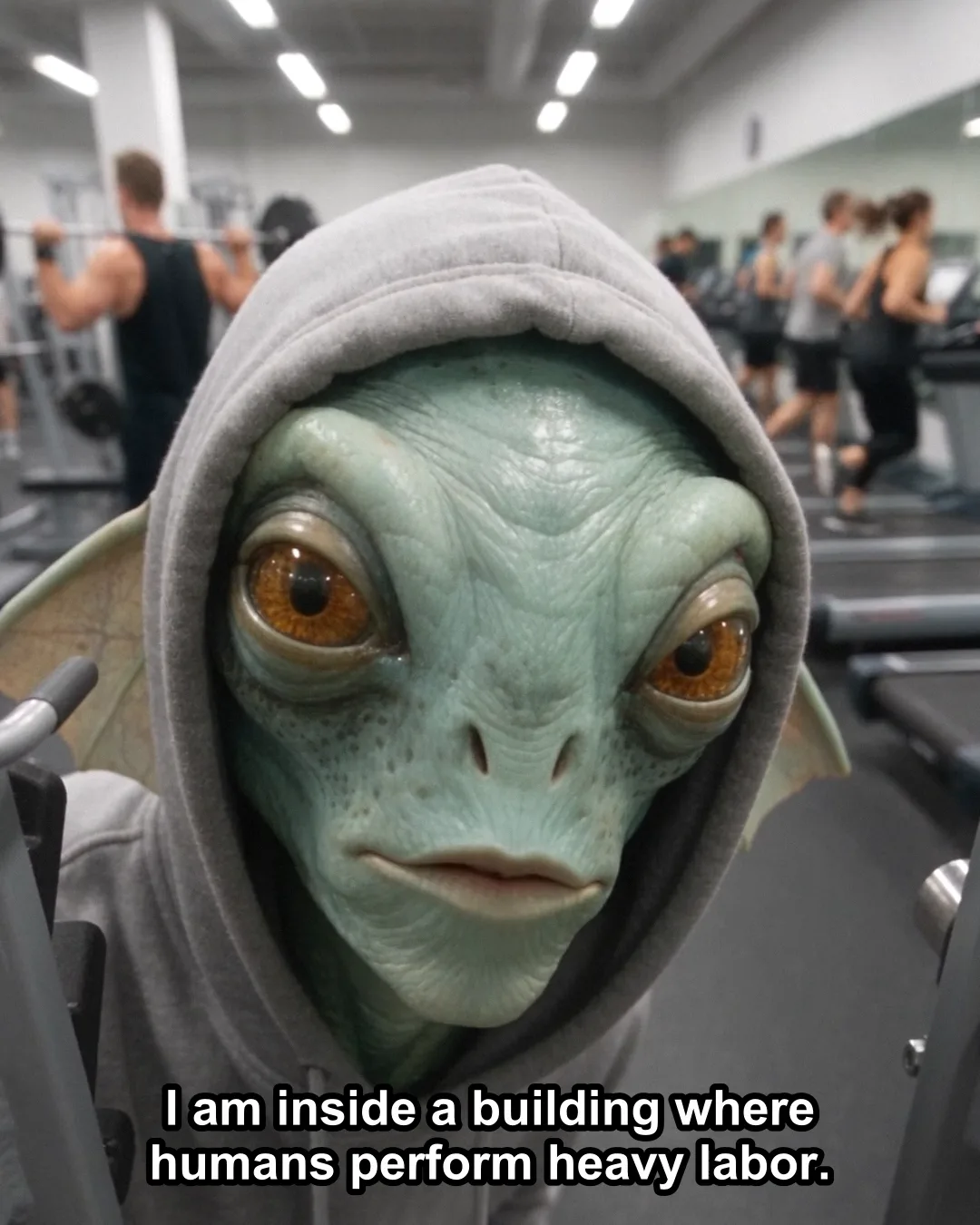
A frame from Oru's gym reel with the captions added in the final cut. Oru is a fictional alien character. Made with Threadwright. Follow @oru.thealien on Instagram
Why do reels need captions?
Reels need captions because many people watch with the sound off, and captions also make a video usable for deaf and hard-of-hearing viewers. The W3C's accessibility guidance recommends captions for any video with speech.
Burned-in captions go further: they show in every app and every download, with no setting to turn on.
Where should captions sit in a vertical video?
Captions belong in the middle of the frame, clear of the top and bottom strips where Instagram, TikTok and YouTube place their buttons and caption bars. Meta's guide to the safe zone for Stories and Reels ads shows the areas to keep clear.
Threadwright places captions inside that safe area, so no button covers a word.
Are burned-in captions the same as a subtitle file?
No. Burned-in captions are part of the picture and cannot be turned off, while a subtitle file such as SRT is a separate track the viewer can switch on and off. YouTube accepts several caption file formats for its own caption track.
Threadwright burns captions into the assembled reel, and a cut with burned-in captions adds a small credit charge.
When the trial ends you have no plan, and nothing is charged unless you choose one.
Before you begin.
Are the captions accurate?+
The captions are the words of your script, timed to the voice take, so they match what is said. Read them once in the preview, and fix any word by editing the script and assembling again. The Submagic comparison covers tools that caption footage you already filmed.
Can I turn captions off?+
Yes. A project's cut holds captions unless you turn them off, and you are charged only when captions were burned in.
Do I need to know which AI model to use?+
No. Threadwright picks the tools for each step and builds the prompts around your character and scene. You bring the idea and the taste.
Can my own assistant use Threadwright?+
Yes. Your assistant can do what the browser does over the API, at the same credit cost. Agent access needs a plan, and the trial counts.